AI
CustomsLens – Building a complete customs platform, from scratch
8 API integrations, AI document processing, and a bunch of lessons learned
Customs handling isn't sexy. It's paperwork, rules, and a lot of manual retyping. But that's exactly where the opportunity lies: if something is tedious and repetitive, you can automate it. With CustomsLens, we saw that opportunity.
Impact
Resultaten
90%
less manual data entry
8
API integrations
Aanpak
Uitdaging en oplossing
De Uitdaging
- Endless retyping – Employees were literally retyping invoices into systems. Line by line. That's not just slow, it's also error-prone
- Documents everywhere – In email, WhatsApp, on desks, in folders. Nobody knew where the latest version was
- HS codes are a nightmare – Thousands of codes, and choosing the wrong one means the wrong tariffs or fines
- Signatures via the printer – Print, sign, scan, email. In 2024. Really
- Everyone works past each other – Traders, freight forwarders, brokers – all with their own Excel sheets and email chains
Onze Oplossing
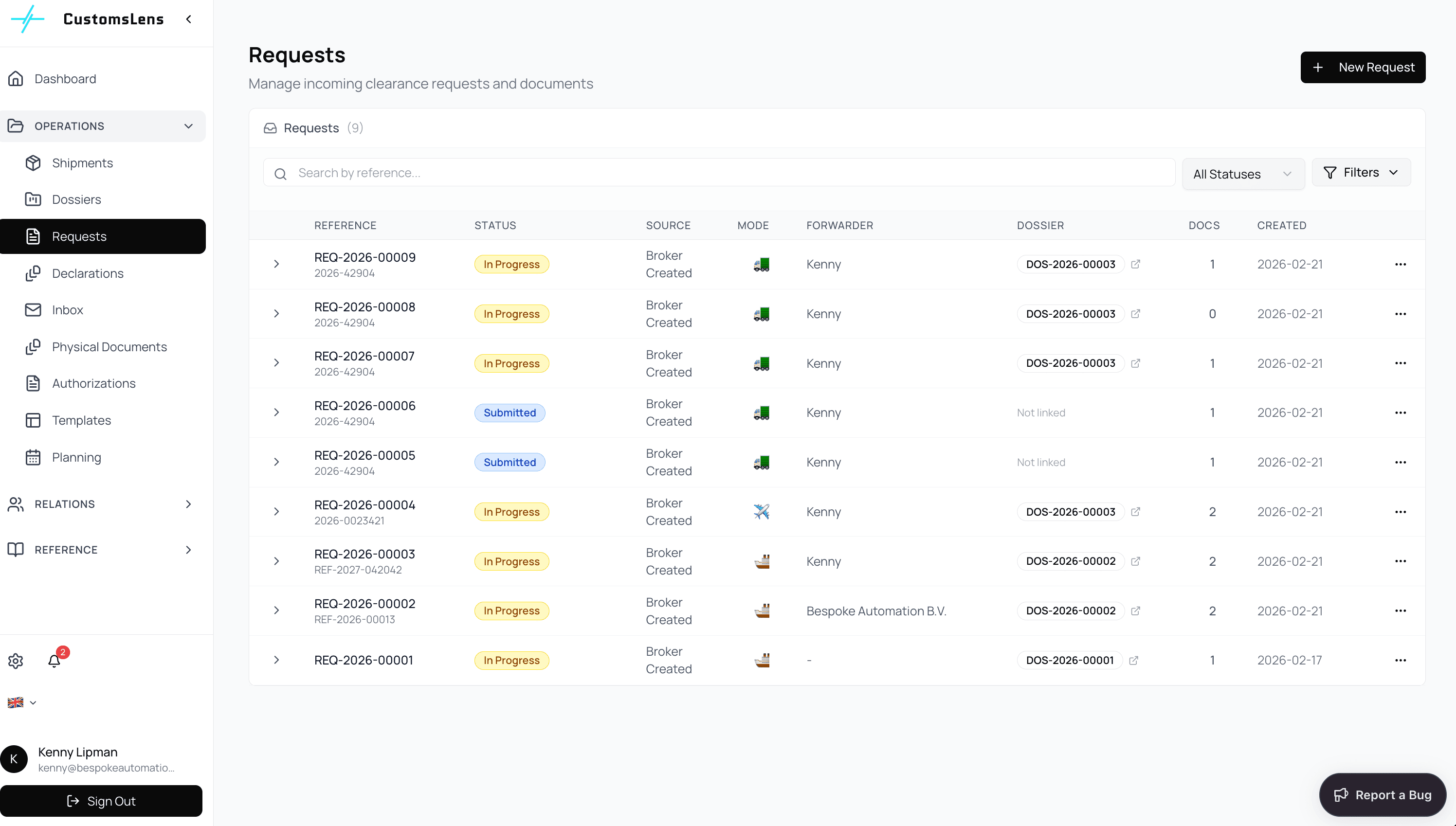
- AI that reads invoices – Upload a PDF, and OpenAI Vision extracts all the data. Company names, addresses, line items, amounts. The user checks it and adjusts where needed. Done
- One place for all documents – Simple, but essential. Everything lives with the shipment, with version control and a clear status
- HS code search that works – A search function that links directly to the EU TARIC database. Type "cotton shirt" and you get the right code along with the tariff
- Digital signing – DocuSeal integration. Send a document, receive a signature. No printer needed
- Roles that make sense – Traders see their own stuff, brokers see what they need to see, admins manage the team. Logical, but it still has to be built
Where it began
With CustomsLens, we're solving a clear problem: customs handling takes too much time and goes wrong too often. Their customers – importers, exporters, freight forwarders – were losing hours to administration that was largely repetitive.
The question was simple: can you automate this?
What we built
We started with the biggest pain points. First invoice processing, since that's where most of the time was being wasted.
The AI extraction
This is where it got interesting. We use OpenAI's Vision API to read commercial invoices. Not just the text – the AI understands the structure. It knows that the amount in the bottom right is usually the total, that the table in the middle contains the line items, and that the address in the top left is the exporter.
It doesn't work perfectly. Sometimes it picks up the wrong field, sometimes it misses a line. But in 90%+ of cases it's correct, and the user only has to make corrections instead of typing everything in themselves. That's the difference between 20 minutes and 2 minutes per invoice.
The TARIC integration
HS codes are the classification codes for goods at customs. There are thousands of them, and choosing the right one is crucial – the wrong code means the wrong import duties.
We built a direct link to the EU TARIC database. You search by description ("hardwood garden furniture") or by code ("9403.60"), and you immediately see the tariff and any restrictions. No more digging through PDFs.
The rest of the platform
Around that, we built what you'd expect from a modern SaaS platform:
- Document management with categories and status tracking
- Digital signing via DocuSeal
- Shipment wizard that guides you through the process
- Dashboard with filters, search, and bulk actions
- Location tracking via Google Maps
- Team management with invitations and roles
The integrations
This project once again taught us how much work external integrations are. We connected with:
- OpenAI Vision (document AI)
- EU TARIC API (customs tariffs)
- DocuSeal (signing)
- Google Places (locations)
- KVK API (NL company data)
- VAT Sense (EU VAT validation)
- Twilio (SMS verification)
- SendGrid (email)
Every integration has its own quirks. Rate limits, authentication flows, error handling, edge cases. It's never "just hooking up an API."
The technical choices
Supabase as the backend – We wanted to build quickly without writing a complete backend. Supabase gives you PostgreSQL, authentication, and storage out-of-the-box. Row Level Security ensures that data from different organizations stays strictly separated.
Next.js 14 with App Router – Server components where possible, client components where necessary. Good performance, good developer experience.
Tailwind + shadcn/ui – No time wasted on custom design systems. shadcn gives you solid components that you can customize.
What we learned
Every project teaches you something. With CustomsLens:
- AI is powerful but not magic – You have to catch edge cases, build in feedback loops, and accept that it won't be 100%
- Domain knowledge is essential – We spent a lot of time understanding how customs handling works. Without that knowledge, you build the wrong things
- Multi-tenant is complex – Five user roles with different permissions, combined with organization-level permissions. You need to design that properly from the start
Where it stands now
CustomsLens is now used by companies that deal with customs on a daily basis. The feedback is positive – the AI extraction and the HS code search function are mentioned most often.
There's still plenty to build. More automation, smarter suggestions, better reporting. But the foundation is there, and that foundation works.
Stack
Gebruikte technologieën
“The AI extraction genuinely saves us hours every week. It's not perfect, sometimes you have to adjust something, but it's so much better than typing everything in yourself. And that HS code search function – finally something that just works.”
Martijn de Vries
Operations Manager
Ook interessant
Gerelateerde case studies

Pigeon Photo Merger – Pigeon Photos Without Photoshop Skills
Stichting Pigeon Global Promotions had a problem: creating professional pigeon photos took a Photoshop expert 45 minutes per photo. We built a tool that lets anyone achieve the same result in 2 minutes. No Photoshop needed, just AI.

From Manual Product Photography to AI-Generated Lifestyle Images in 2 Minutes
Florafy needed at least 5 types of product photos for every plant: lifestyle shots, close-ups, dimensions, and packaging photos. We built an AI platform that automatically generates professional product images via Google Gemini and pushes them to Shopify with a single click. The result: ~90% time savings per product and 99% lower costs per image.
Van handmatige productfotografie naar AI-gegenereerde sfeerbeelden in 2 minuten
Florafy had voor elke plant minimaal 5 soorten productfoto's nodig: sfeerbeelden, close-ups, afmetingen en verpakkingsfoto's. We bouwden een AI-platform dat automatisch professionele productafbeeldingen genereert via Google Gemini en ze met één klik naar Shopify pusht. Het resultaat: ~90% tijdsbesparing per product en 99% lagere kosten per afbeelding.
Volgende stap
Klaar om jouw processen te automatiseren?
Ontdek hoe wij ook jouw bedrijf kunnen helpen met slimme automatiseringen die tijd en geld besparen.